
Lighting Units – Altman ERS and Friends
(Original article written in the mid‑1990s, lightly updated today)
This page began life in the mid‑1990s as a basic guide to the Altman ellipsoidals and other conventional fixtures I used when I was teaching at The Berkeley Carroll School in Brooklyn, NY. It remains online and maintained because so many schools and small theatres still rely on these older incandescent units in day‑to‑day production work.
Today, most new installations have shifted toward LED fixtures, with ETC’s Source Four family becoming the most common reference point for modern ellipsoidals. If you are working in a venue full of Altman 360Q units, think of this page as both a retrospective and a practical survival guide for keeping those classics working.
Today’s Technology vs. These Classics
Since this article was first drafted in the mid‑90s, manufacturers have made enormous gains in efficiency, optics, and control. LED ellipsoidals, Fresnels, cyc units, and moving fixtures now deliver more output per watt, longer life, and far better color control than the incandescent Altman 360Q ever could.
The ETC Source Four quickly became the dominant ERS in professional and educational theatres, and its LED descendants are now standard issue in many new builds. Even so, the older Altman 360 and 360Q fixtures still teach the same fundamental lessons about beam control, focus, and color that apply to every modern light you will encounter.
What Makes an ERS an ERS?
ERS units are sometimes called by brand names: “Leko” (from the original Lekolite) or “Source Four” (ETC’s popular line). Whatever the nickname, they share a few key traits:
-
Internal shutters to crop the beam
-
A slot for color (gel) in front of the lens
-
A gobo slot in front of the shutters
-
One or more focusing lenses with smooth, full glass (not stepped)
In an ERS, the lamp sits inside an ellipsoidal reflector. The filament lives at one focal point of that ellipse, and the opening to the lens tube sits at the other. Shutters and gobos live around that internal focal point, which is why you can get such crisp cuts and sharply focused patterns.
In the UK, you are more likely to hear these called “profiles” rather than ERS units.
Altman 360 vs 360Q
Some of the original Berkeley Carroll fixtures were Altman 360 units, and others were Altman 360Q. The “Q” stands for Quartz, referring to the quartz‑halogen lamp used in the 360Q series. The non‑Q 360 units used a standard incandescent lamp instead.
You can spot the difference from the shape of the lamp housing:
-
360Q: lamp housing stands straight up on the top of the unit.
-
360: lamp housing is offset and banana‑shaped to one side.
Both versions are now considered “vintage,” but thousands are still in service in school and community theatres.
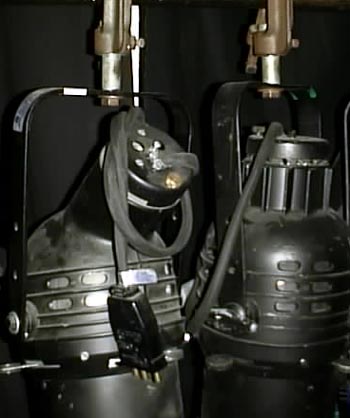
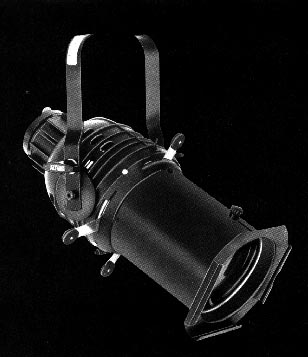
The Berkeley Carroll “Leko” Inventory
When this guide was first written, Berkeley Carroll School owned a mix of Altman 360Q ellipsoidals, along with a few non‑Q Altman 360 units. In the booth and on the pipes, they were casually called “Lekos,” even though they were Altman brand units rather than original Lekolite fixtures.
BCS owned the following Altman ellipsoidals:
-
6 1/2″ x 4 1/2″
-
6″ x 9″
-
6″ x 8″
-
6″ x 12″
-
6″ x 16″
All of these are ERS units: Ellipsoidal Reflector Spotlights. They are the workhorses of most theatres, covering everything from basic area washes to tight specials, from long FOH throws to shin‑level side light.
Fresnels
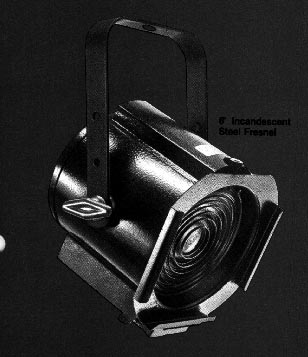
Fresnels are named for their distinctive Fresnel lens, which has a stepped front surface and a stippled (bumpy) back to soften the beam. Common sizes are 4‑inch, 6‑inch, and 8‑inch, referring to the lens diameter.
Inside, a spherical reflector sits behind the lamp, and the lamp/reflector assembly slides forward and back to change from flood to spot. Because the reflector cannot be larger than the lens opening, Fresnels are relatively inefficient, and the beam gets dimmer as you “spot in” to tighter focuses.
Key traits:
-
Soft‑edged circular beam
-
No internal shutters (you use barndoors instead)
-
Best for general area washes, top light, and back light, not tight specials
Many Fresnel lamps are base‑down only, with the bulb up. If you burn them in the wrong orientation, lamp life drops dramatically.
This is a 6″ Fresnel. The Fresnel uses a Fresnel lens, hence, its name. This unit provides a soft, circular light and is often used for back light and down light. At least in our theater.
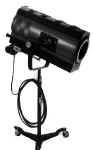
This is an Altman followspot. Please have at least two people to raise or lower this light on it’s stand. I’ve seen, too often, somebody trying to lower it and get their hand caught and pinched.
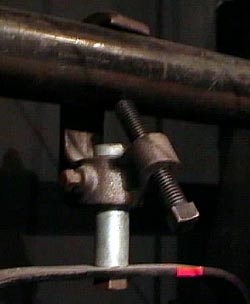
Altman C-Clamp
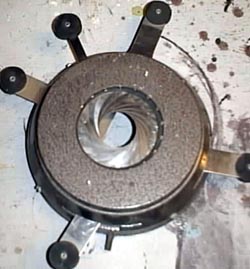
Shutter and Iris module
PAR Cans
PAR (Parabolic Aluminized Reflector) lights look a lot like oversized car headlights. The lamp, reflector, and lens form a sealed package, and you cannot change the relationship between filament and lens.
A typical PAR can produces an intense oval pool of light with soft edges. You can rotate the lamp inside the can to rotate that oval, but you cannot sharpen or soften the edge the way you can with an ERS. Lenses come in a few standard spreads: wide flood (WFL), medium flood (MFL), narrow spot (NSP), and very narrow spot (VNSP).
Common sizes include PAR56 and PAR64, where the number equals the diameter in eighths of an inch (a PAR64 is 8 inches in diameter). PARs are staples of concert and rock‑and‑roll rigs, especially with haze in the air to show beams, but they see less use as precise FOH instruments in traditional theatre.
One important exception is ETC’s Source Four PAR, which uses a separate halogen lamp and interchangeable lenses rather than a sealed beam lamp.
Strip (Border) and Cyc Lights
Strip lights and cyc lights are long fixtures with multiple lamps arranged in a row. They typically throw light outward at right angles to their length.
A strip or cyc unit often has three or four circuits, each with a different color (commonly red, green, blue, and sometimes amber). By blending the intensities of these circuits, you can create a wide range of colors on a backdrop, cyclorama, or stage floor.
These fixtures are ideal for:
-
Coloring a cyc or sky drop
-
Low, even footlight or groundrow light
-
Broad color washes across large areas
Scoops
Scoops are large, open‑faced fixtures with a simple reflector and no lens. They are inexpensive and very forgiving, but they offer almost no control over the beam.
Because there is no lens system, you cannot sharpen the edge of the light or easily shape it. Scoops are handy for worklight, dead‑simple stage washes, or lighting a cyc in a pinch when nothing else is available.
House Lights and Work Lights
House lights provide illumination for the audience before and after the show and during intermission. They are usually incandescent or fluorescent floods, often on dimmers but sometimes on simple switches.
Work lights are the backstage and onstage utility lights used for load‑ins, rehearsals, and maintenance. These are almost always switched, not dimmed, and are usually off during performances unless deliberately included in the design.
Moving lights or intelligent fixtures were originally implemented in 1972, but the first computer-controlled stage lighting fixtures began to gain widespread acceptance in the concert industry in the early 1980’s. As the digital age progressed, the cost of these fixtures was reduced and they slowly started being used in more ‘traditional’ theatrical environments. Intelligent fixtures are currently used in almost all major theatrical productions.
Usually relying on compact Arc Lamps as a light source, these fixtures generally use Stepper Motors connected to varying internal devices to manipulate the light before it escapes the fixtures front lens.
Examples of internal devices are:
- Color wheels with dichroic lenses used to change the color of the beam.
- Pattern wheels with Gobos used to change the shape of the beam.
- Shutters used to ‘dim’ or ‘strobe’ the output
- Automated lens trains used to focus the beam.
- Irises used to change the size of the beam.
- Gate shutters to ‘square off’ the beam.
- CMY color wheels using subtractive colors to change beam color by inserting dichroic glass filters with varying levels of color filtering into the optics chain.
- Prisms
The majority of these fixtures also use Stepper Motors to enable movement of the light fixtures output by either moving a mirror which reflects the beam, or by moving the entire fixture lens train. This allows the fixture to cover large areas by varying the X-Y coordinates of the beam. Higher performance fixtures use stepper motors for pan and tilt motion.
Moving lights are controlled in many ways. Usually the fixtures are connected to a Lighting Console, which outputs a control signal. This control signal sends data to the fixture usually in one of three ways – Analog (which has largely been phased out), DMX (which is the industry standard control protocol), or Ethernet Control (which is still in development). The fixture then takes this signal and translates it into internal signals which are sent to the many stepper motors located inside.