
Curtains are hung in either of a few ways. Flat or full are the most popular. Flat is simply hanging the cloth stretched across the pipe. Pulled tight it looks like a sheet on a clothes line.
Flat vs. full curtains
Curtains are commonly hung either flat or full, and the method you choose changes both the look and the amount of fabric you need. Flat is simply hanging the cloth stretched across the pipe so it reads as a smooth, almost two‑dimensional surface. Pulled tight, it looks like a sheet on a clothesline, which can be very useful for simple backdrops, projections, or anytime you want a clean, neutral background.
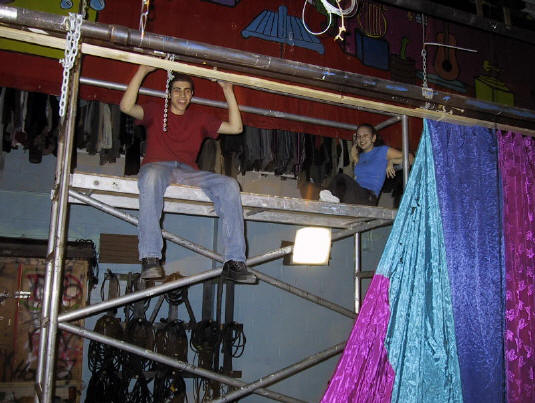
Fabric across the batten
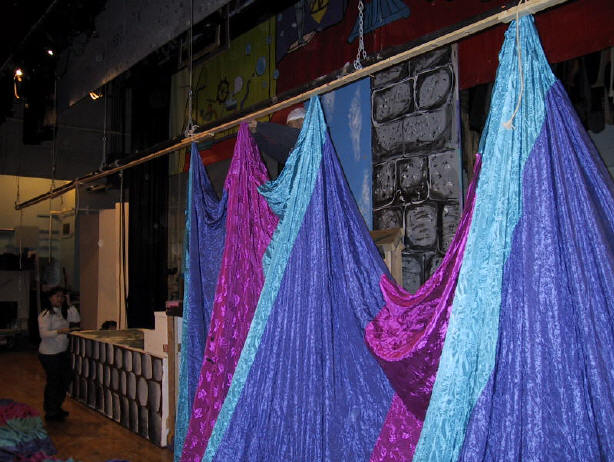
Full curtain: extra fabric ‘bunched’ on the batten to create soft waves and fullness across the span.
A tab curtain is a special way of hanging and operating a pair of drapes so they open on a diagonal rather than straight sideways. Tab curtains can be made from either flat or full goods; in the example photo, the curtain is full, which you can see from the repeating waves running vertically in the fabric.
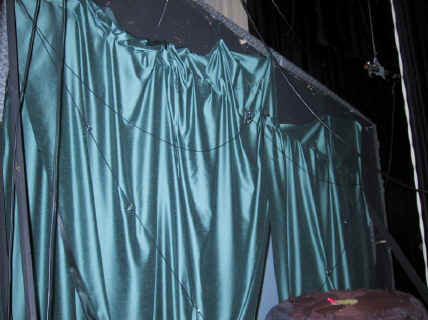
Tab curtain: two overlapping panels hung full on a batten so they can open on a diagonal instead of straight sideways.
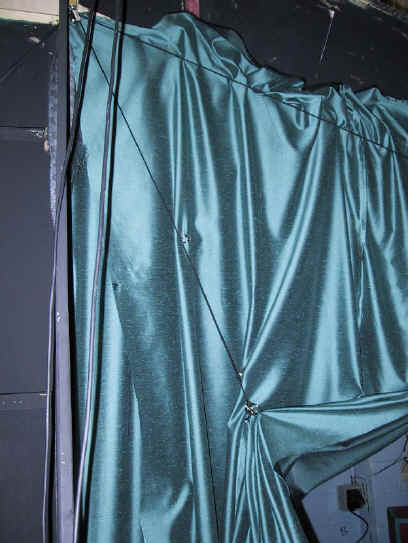
Pulling the operating line draws a series of pickups, making the curtain twist and sweep up toward the offstage rigging point.
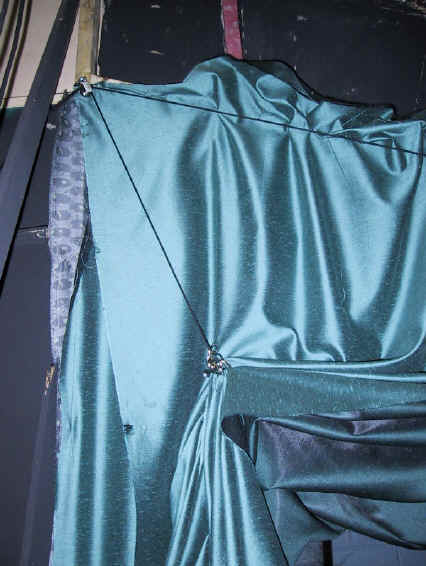
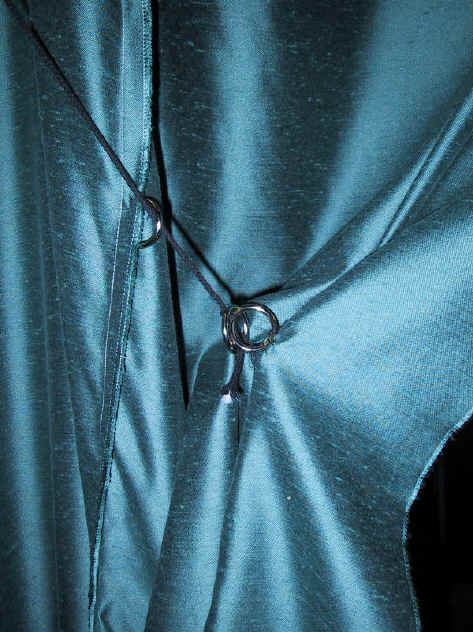
Small rings sewn to the back guide the tie lines so each pickup happens in the same place every time.
Creating a flying “window” drape without fly space
In one production, the design called for a grand window upstage center that could appear and disappear very quickly in an otherwise simple setting. The “window” itself was not built scenery; instead, a window pattern was projected onto a set of long drapes, which gave the illusion of an architectural opening when the projection was on, and the curtain was in view.
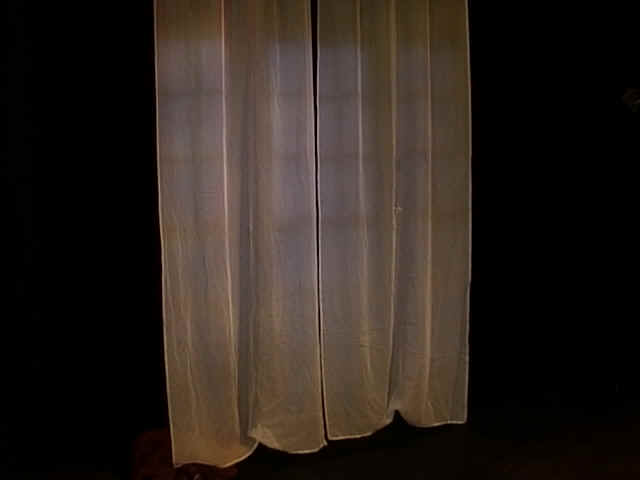
Tall white drapes hung on a batten become a ‘window’ when we add a gobo projection of window panes.
The easiest solution would normally be to fly the drape in and out, but this theatre had no real fly space, meaning there was no room above the lighting pipes to lift the curtain completely out of sight.
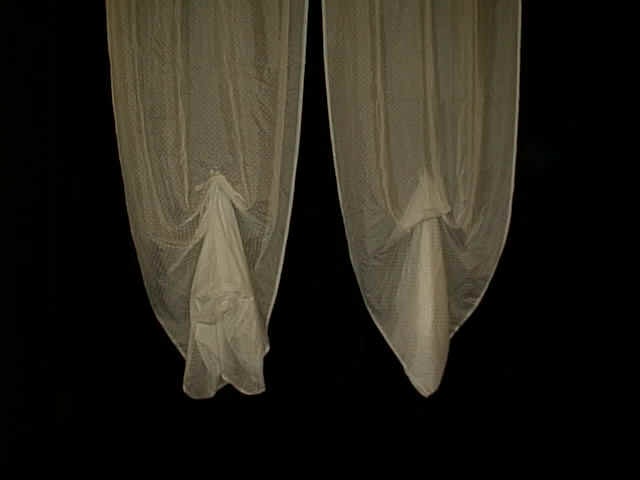
Because there is no fly space above the lights, the curtain is designed to lift from the bottom instead of flying straight up.
Instead of pulling the drape upward from the top like a standard flown piece, the curtain was lifted from the bottom using black tie line. The tie lines ran through a series of white rings sewn to the back of the curtain so they would track straight up the fabric. As the line was pulled, the bottom edge gathered toward the batten, gradually folding the drape up into a compact bundle that could clear the sightlines even in a low grid.
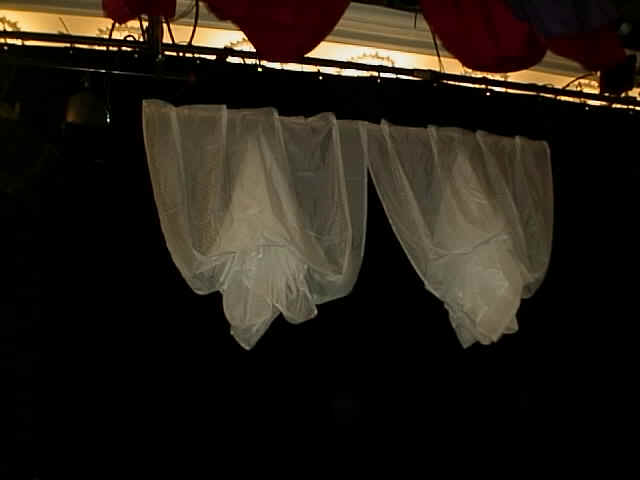
Black tie line runs through white rings sewn down the back of the curtain so we can gather it cleanly
Using weights and rings to gather a curtain
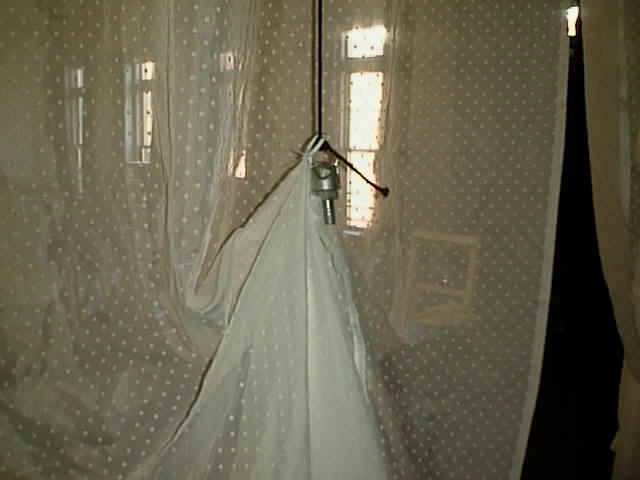
In the close‑up photo, you can see the weight (a very large cable clamp) catching one of the rings sewn to the back of the curtain. As the tie line is pulled, the weight slides upward and picks up each ring in sequence. Each ring that is lifted pulls another section of fabric up, so the curtain “nests” into itself in a controlled way rather than bunching randomly. When the stack of fabric reaches the batten at the top, the system then begins to lift the batten as well, carrying the entire unit out of view as far as the ceiling height allows. This is a handy technique for schools with low ceilings that still want the basic function of a fly system without the full height of a professional stage.
-
A heavy cable clamp acts as a sliding weight that catches each ring as the line is pulled.
-
Every time the weight picks up another ring, that section of fabric is pulled up toward the batten.
-
Once all the rings are gathered, the system begins lifting the batten itself, raising the whole bundle out of the audience’s sightlines.
Flat‑hung red curtains in “out” position
The red curtains shown in the later photos are rigged with the same bottom‑lift system as the white “window” drapes. These are a good example of a curtain hung flat: the fabric is stretched more evenly across the pipe so the surface is smoother, with shallower folds.
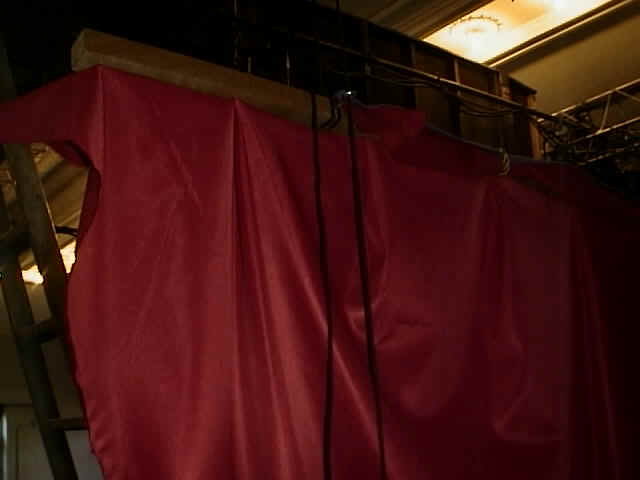
Red curtain hung flat on the batten: less fullness, smoother surface, easier to read as a solid backdrop
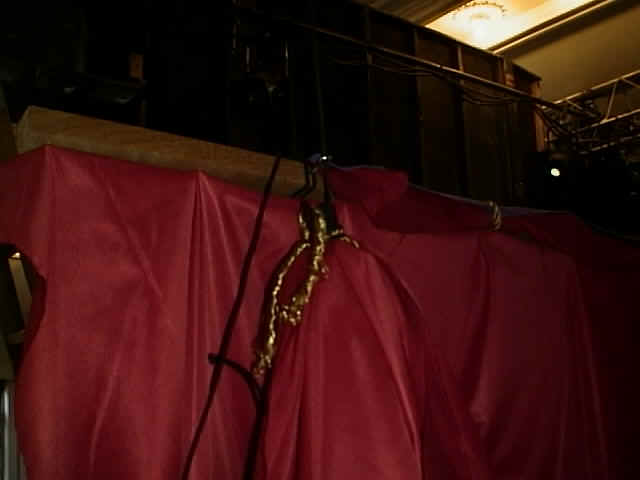
The same bottom‑lift system of tie lines and rings gathers this curtain up into a compact stack.
When the curtain is in its “out” position, it has been gathered up by the rings and tie lines into a tidy stack near the batten so it no longer plays in the audience’s main sightlines. From the house, the audience mostly sees other elements of the set and lighting, while the stored curtain reads as a compact bundle that can be quickly released to drop back into view for the next scene.
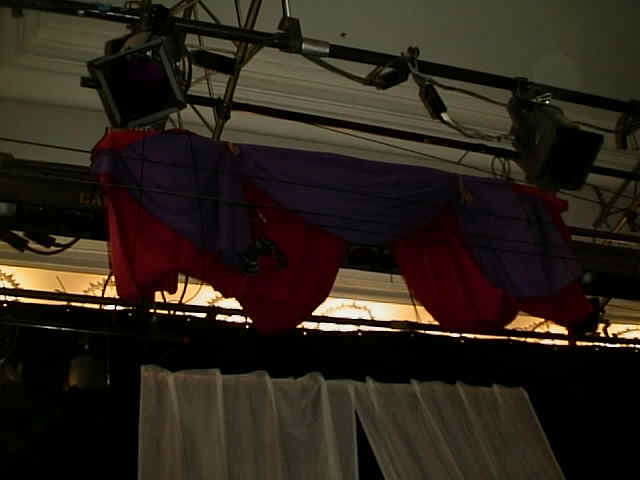
This photo shows the curtain in its ‘out’ position, stored up near the batten so the stage behind is clear for the scene.