
How Lighting Designers Read a Script: Building Your Lighting “Shopping List”
When you plan stage lighting for a play or musical, the first step is not hanging instruments or programming cues. It is reading the script and building a script‑based lighting shopping list. That list gathers every lighting need in one place, making your design clearer, cueing easier, and the final look on stage stronger.
When a lighting designer reads a script, the goal is not just to enjoy the story. It is to discover everything the light must do to tell that story on stage. A simple, powerful way to track those needs is to build a lighting shopping list as you read.
The shopping list is not about gear yet. You are not choosing instruments or counting dimmers. Instead, you are building a scene‑by‑scene list of moments: times of day, changes in location, practical lamps that need to work, special effects like lightning, and any other lighting events the audience should notice. By the time you finish the script, that list becomes your roadmap for later steps such as visual research, cueing, and eventually the light plot and channel hookup.
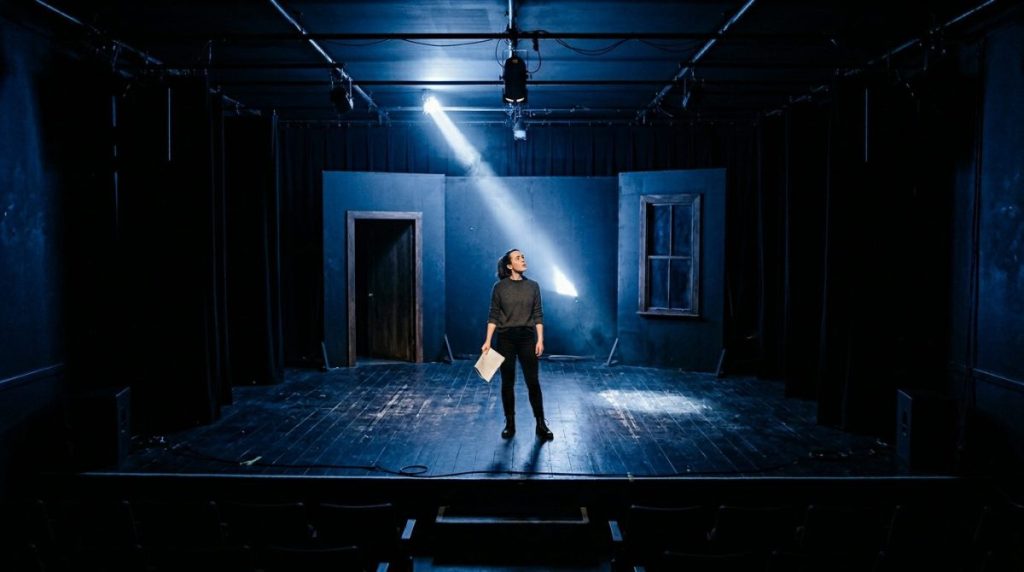
student lighting designer reading a script
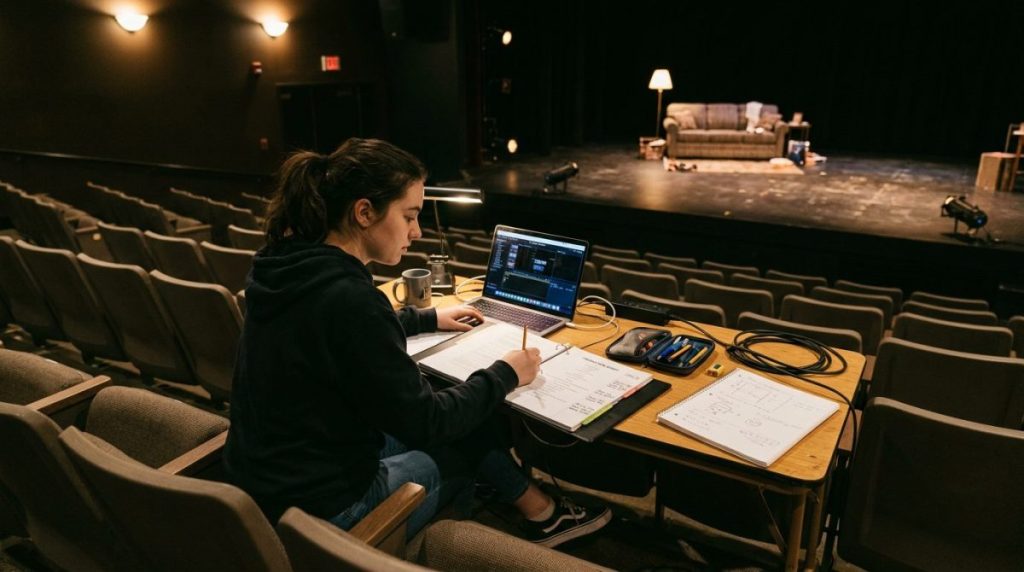 student lighting designer reading a script
What is a Lighting Shopping List?
Think of the shopping list as a running log of everything the light has to support in the show. You are collecting clues, not solving the entire puzzle yet.
You can do this in a notebook, but a simple spreadsheet works even better. Create columns such as:
-
Act
-
Scene
-
Page
-
Event (what is happening)
-
Time (time of day / passage of time)
-
Motivation (where the light “comes from” in the story)
-
Notes (your thoughts about the lighting at that moment)
-
Cue for later (if it feels like a cue point)
You do not need to fill in every column for every line. Just capture each moment where the light might need to shift or do something specific. Over time, this list will grow into your first cue list and inform your design choices.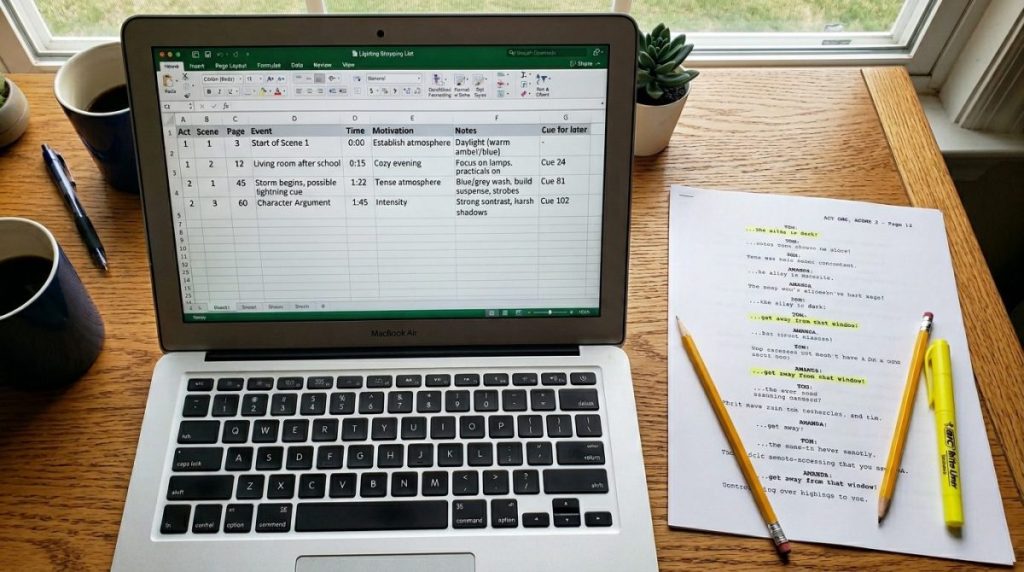
Step‑by‑Step Script‑Reading Checklist
Below is a student‑friendly script‑reading checklist you can use for any play or musical. Take it one scene at a time. You do not need to answer every question on the first read. Plan on reading the script at least twice: once to experience the story, and again (or a third time) to mine it for lighting clues.
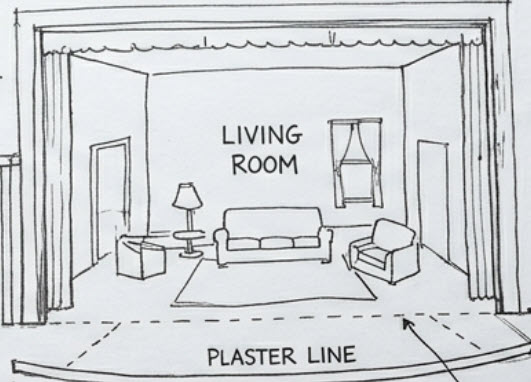
1. Where are we?
Every scene happens somewhere, and that “somewhere” matters to light.
Ask yourself:
-
Is this indoors (living room, classroom, office) or outdoors (street, park, forest, rooftop)?
-
Is the space small and intimate, or large and open?
-
Is it realistic, or more abstract and theatrical?
In your shopping list, write a short phrase such as:
-
“Act I, Scene 2 – High school hallway, realistic, fluorescent overhead feel”
-
“Act II, Scene 1 – Forest clearing at night, open space”
These notes will help you later when you design the overall environment and decide what needs to be lit and what can fall away into shadow.
2. What time is it?
Lighting is the fastest way to tell the audience whether it is morning, afternoon, sunset, or the middle of the night.
As you read, look for clues:
-
Is it “early morning,” “late afternoon,” “evening,” “midnight,” “dawn”?
-
Does the script mention clocks, school bells, or specific times?
-
Does the director’s note or scene heading mention time of day?
In your list, keep it simple:
-
“Time: Late afternoon”
-
“Time: 2 a.m., middle of the night”
-
“Time: Sunset moving into night over the scene”
Each time the time of day changes between scenes, that is a new line on your shopping list. If time changes during a single scene (for example, sunset into night), treat that as an additional moment you will probably need to support with a cue.
3. Does time pass during the scene?
Sometimes the script jumps forward instantly between scenes. Other times, time passes while the scene continues. That creates opportunities for subtle lighting changes.
Look for things like:
-
“An hour later…” in stage directions
-
Characters saying things like “It’s getting late” or “The sun is going down”
-
A transition from after‑school to late night during a long scene
In your shopping list, write notes such as:
-
“Time passes: afternoon to evening during Scene 3”
-
“Slow shift: sunset to night during song”
These notes tell you later that you may need a slow fade or a series of cues instead of a single static look.
4. What is the main source of light in the story?
In lighting design, this is called the motivating light. The audience might not think about it consciously, but you should. Ask, “If I were standing inside this scene, where would the light really be coming from?”
For each scene, ask:
-
Is the light coming from the sun through a window?
-
From the moon? Streetlights? A campfire? Flashlights?
-
From overhead fluorescent fixtures in a school?
-
From footlights in a vaudeville theater?
-
From candles, lanterns, or oil lamps in a period piece?
Write what you find in your shopping list:
-
“Motivation: afternoon sun through big window, house interior”
-
“Motivation: flickering streetlamps in 1840s London, stormy night”
-
“Motivation: cold fluorescent classroom lights overhead”
You are not picking gel colors yet. You are just naming the “story source” that will guide your color, angle, and intensity choices.
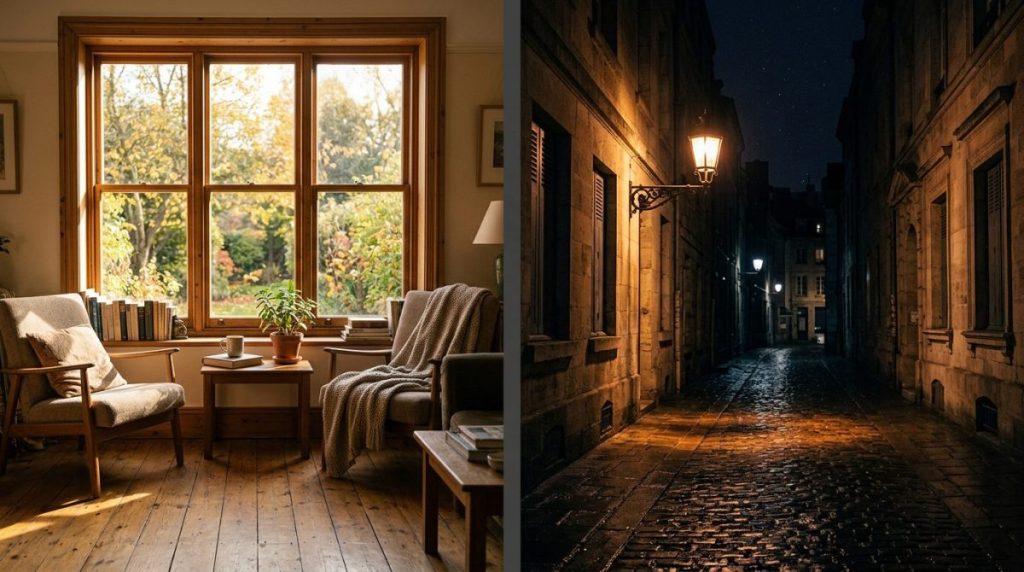 Side‑by‑side photos: one of sunlight through a window; one of a street at night lit by a single streetlamp.
5. What practical lights are mentioned?
Practicals are real, visible light sources on stage that the audience can see: table lamps, floor lamps, chandeliers, sconces, candles, lanterns, TV screens, glowing phones, neon signs, and so on.
As you read, highlight or underline any line that mentions:
-
“He turns on the lamp.”
-
“The chandelier flickers.”
-
“The candles are blown out.”
-
“The sign lights up.”
Each time you see one, add an item:
-
“Practical: table lamp SR – must turn on when Character A enters”
-
“Practical: chandelier – flickers in storm, then goes out”
-
“Practical: string lights over backyard – soft glow all scene”
These practicals often drive specific cues and can require extra preparation with your electrics team. Identifying them early saves a lot of scrambling later.
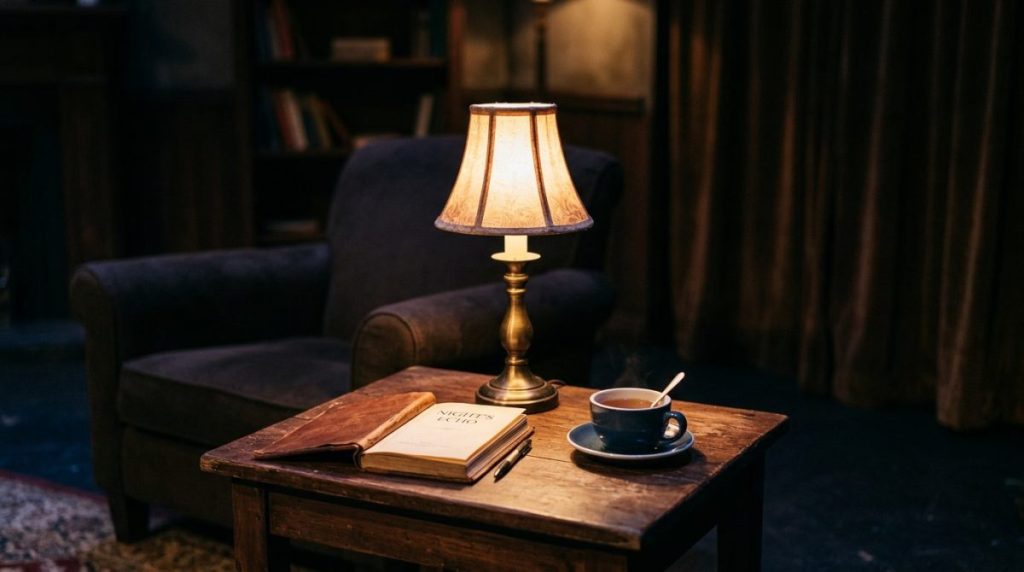 Close‑up photo of a table lamp on a set
6. What does the audience absolutely need to see?
Not every inch of the stage needs to be bright. However, some moments must be completely clear.
Watch for:
-
Important entrances and exits
-
Key props being read or revealed (letters, photos, weapons, rings)
-
Important physical action (a slap, a hug, a fight, a fall)
-
Key emotional moments (someone alone on a bench, a quiet confession)
Add notes such as:
-
“Need clear light on dining table when letter is read”
-
“Isolate front porch for confrontation”
-
“Keep focus on piano and singer, chorus can be darker”
These are early hints for specials and focused areas you will want in your plot.
7. Are there special lighting events or effects?
These are the “fun” moments, but they need to be planned just as carefully as everything else.
Look for:
-
Storms and lightning
-
Gunshots or explosions
-
Magic moments or transformations
-
Dream or fantasy sequences
-
Flashbacks or “out of time” moments
-
Full blackouts or rapid changes in light
Any time the script suggests a big shift, add it:
-
“Lightning flashes during argument”
-
“Blackout at end of Act I”
-
“Dream sequence: surreal color shift, softer edges”
-
“Flashback: looks different from present‑day scenes”
You are not deciding the exact cue timing yet, just capturing where effects will be needed.
8. What is the mood or emotional tone?
Even if the script does not say “the lights change,” the mood often tells you that they should. A quiet, intimate moment should not feel like the same light as a bright musical number or a tense horror beat.
Ask yourself:
-
Is this moment warm and friendly, or cold and harsh?
-
Is it hopeful, romantic, lonely, dangerous, mysterious, playful?
-
Does the mood shift partway through the scene?
In your list, use simple mood words:
-
“Mood: cozy and safe, family at home”
-
“Mood: sharp, cold, high tension”
-
“Mood: magical, time‑stops feeling”
These mood notes will eventually inform your choices of color, angle, and intensity.
9. What does not need to be seen?
A big part of lighting design is deciding what should stay dark. Shadows are just as important as light.
Ask:
-
Are there parts of the set that should stay in shadow to keep the focus clear?
-
Do you want to hide scene changes or backstage traffic?
-
Is there a reason to conceal certain scenery elements until a reveal?
Write notes like:
-
“Keep upstage hallway dark except when used”
-
“Hide wings during scene change”
-
“No light on storage area SL – distracts from main action”
These notes remind you later to avoid washing the entire stage with flat, even light.
10. Does this feel like a cue?
Finally, pay attention to your instincts. If a line, a movement, or a music hit feels like a natural cue point, mark it. You can decide later whether it becomes a full lighting change, a subtle shift, or nothing at all.
Examples:
-
“Cue for later: ‘And then everything changed’ – possible shift in color or focus”
-
“Cue for later: music button at end of song, blackout or big transition”
-
“Cue for later: door slam – cut backlight, isolate central character”
Give yourself permission to over‑mark at this stage. You can always delete or combine cues when you get into rehearsals and cueing sessions.
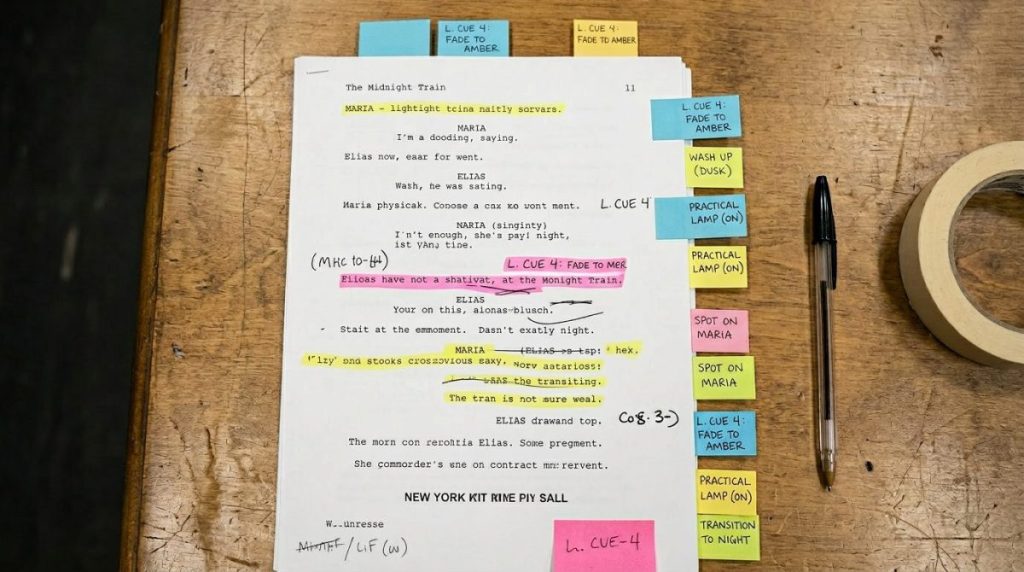 Script page with highlighter marks and sticky notes where cues might go.
Putting It All Together
If you follow this checklist for an entire script, you will finish with:
-
A clear list of locations and times of day
-
A map of every motivating light source and practical
-
A set of must‑see moments and intentional shadows
-
A list of special events and potential cue points
-
A strong sense of the mood for each scene
At this point, you still have not drawn a light plot or chosen a single instrument. That is the point. The shopping list keeps you focused on what the story needs before you get lost in gear, channel numbers, and technical details. It is your bridge between the words on the page and the light the audience will experience.
For teachers, this checklist can easily become a class exercise: hand out a short scene, have students mark it up, and then compare their shopping lists. You will see immediately whether they are noticing clues about time, place, and mood, or just skimming for “cool effects.”